





Avoid your inquiry is delay response, please enter your WhatsApp/Skype along with the message, so we can contact you at the very first time.
We will reply you within 24 hours. If for urgent case, please add WhatsApp/WeChat: +86 19966487626,. Or call 400-090-5086 directly.
* We respect your confidentiality and all information are protected. We will only use your information to respond to your inquiry and will never send unsolicited emails or promotional messages.
Why Is My Gearbox Getting Hotter? Causes and First Checks
Gearbox getting hotter? A practical guide to temperature rise, changing operating conditions and the first checks to make.
The gearbox used to run at a consistent temperature. Now it gets hotter during the same shift. Before replacing it or changing the lubricant, establish what changed.
A shorter production cycle, a heavier payload or reduced airflow can change the temperature of a planetary gearbox. Heat may also arrive from the motor or nearby equipment. Internal wear or lubrication problems are possible, but the housing temperature alone cannot tell you which explanation is correct.
The first useful question is:
Under what speed, load and ambient conditions does the temperature increase appear, and does it eventually level off?
Start with comparable readings and the operating limits for the exact gearbox. Then use the timing of the change to decide where to inspect.
Normal gearbox temperature rise and overheating
A gearbox normally warms up after startup. Gear meshing, bearings, seals and lubricant movement generate losses that become heat. Heat leaves through the housing, connected machine structure and surrounding air.
Under steady operating conditions, the temperature should approach a balance. On an intermittent axis, a repeating production cycle may produce a repeatable temperature pattern instead of one constant reading.
A stable reading does not, by itself, establish acceptable operation. Compare it with the temperature limits and performance conditions for the selected model, lubricant and configuration.
Also check whether elevated temperatures require derating, such as a reduction in permitted load. Neugart’s operating manual explicitly instructs users to check whether performance data must be reduced as gearbox temperature rises. This is manufacturer-specific guidance, not a common limit for every planetary gearbox. Neugart operating manual, page 22
A reading below the permitted limit can still deserve investigation if it is significantly higher than the machine’s established baseline under comparable conditions. The change is a reason to inspect, not proof of internal failure.
Confirm the measurement before looking for a fault
Touch cannot establish whether a gearbox is operating within specification. Use the manufacturer’s recommended measurement location and method, and check whether the stated limit refers to the housing, lubricant or ambient temperature.
Record these details with each reading:
- The measurement point on the housing
- Instrument, method and relevant settings
- Local ambient temperature
- Input speed and load or torque
- Operating cycle and time since startup
Comparing a reading taken shortly after startup with one taken after hours of production can create a misleading trend. So can changing the measurement point or instrument.
Infrared readings need particular care on exposed metal. Emissivity settings, surface condition and reflected heat from nearby equipment can affect the result. FLIR explains that low-emissivity polished surfaces can reflect surrounding thermal radiation, causing the instrument to report an apparent temperature that differs from the target’s temperature. FLIR: How emissivity affects thermal imaging
Use the temperature pattern to choose the first checks
The timing of the increase can narrow the investigation. A gearbox that became hotter after a cycle change presents a different starting point from one that warms rapidly with new noise and leakage.
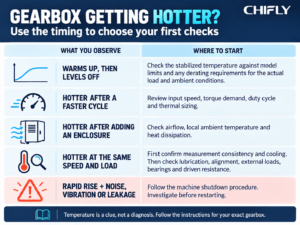 Figure 1. Match the observed temperature pattern to an initial inspection direction. The guide does not identify a failed component or replace model-specific instructions.
Confirm measurement consistency and cooling conditions before moving into detailed mechanical checks. Temperature alone cannot establish whether the gears, bearings, lubricant or installation caused the change.
Check changes in load, speed and duty cycle
The machine may still make the same part while asking more of its transmission.
A shorter cycle can reduce idle time. Higher speed or a heavier payload can change the operating demand. A tighter belt, binding guide or increased process resistance can add load without changing the programmed movement.
Review the production history:
- Has input speed, acceleration or cycle frequency increased?
- Has the payload or process force changed?
- Has the driven mechanism become harder to move?
- Did maintenance alter belt tension, alignment or mounting?
- Is the machine running for longer periods between stops?
Use the revised motion profile to review the gearbox’s mechanical and thermal suitability. Meeting a peak-torque requirement alone does not establish that the gearbox is suitable for sustained operation at the new cycle rate.
Inspect cooling and external heat sources
A new enclosure, blocked airflow or a hotter local environment may reduce heat removal. Check the area around the gearbox rather than relying only on the room temperature recorded elsewhere in the factory.
The mounting arrangement also matters because it provides a path for heat to enter the machine structure. Heat can transfer from the motor through the input connection.
Neugart’s troubleshooting guidance includes inadequate heat dissipation, motor heat transfer and deposits among the factors to review when operating temperature is too high. Use these as inspection directions while following the instructions for the installed gearbox. Neugart operating manual, page 26
Where practical, record gearbox, motor and local ambient temperatures over the same period.
Did the gearbox become hotter on its own, or did the motor and surrounding air become hotter too?
This comparison can help locate the change. It does not prove the source without further inspection.
Review lubrication without adding more by default
Adding lubricant is not a reliable first response to a hot gearbox.
Too little lubricant or an unsuitable product can compromise lubrication. Excess lubricant can increase resistance and heat. In rolling bearings, SKF describes how excess grease can prolong churning and increase frictional losses and temperature. That supports checking the specified quantity, not assuming that every hot gearbox is overfilled. SKF: Grease lubrication mechanisms in rolling bearing systems
For a factory-lubricated precision gearbox, follow the maintenance instructions. Do not open the unit, add lubricant or replace it unless the specified service procedure allows it.
If the gearbox is serviceable, review the approved lubricant, quantity, maintenance history and evidence of leakage or contamination with qualified personnel.
Decide when to stop and investigate
Follow the manufacturer’s instructions if the permitted temperature is exceeded.
A rapid unexplained rise, abnormal mechanical noise, severe vibration or significant leakage also warrants stopping the machine according to its shutdown procedure and investigating before restarting.
Do not continue a deteriorating machine simply to obtain a longer temperature record.
For a gradual increase without an immediate stop condition, record the operating conditions and investigate one possible cause at a time. After corrective work, repeat the measurements at the same points, using the same method and comparable operating conditions. Compare the temperature pattern over a representative running period.
Frequently asked questions
What temperature is too hot for a planetary gearbox?
There is no universal value. Use the limit for the exact model, lubricant and configuration, confirm what temperature is being measured, and check any derating requirements.
Does a hotter gearbox mean the bearings are failing?
Not necessarily. Temperature can change with load, speed, cooling, motor heat or measurement conditions. Bearing condition is one inspection area when the evidence supports it.
Should I add grease if the gearbox gets hot?
Follow the product’s service instructions first. A factory-lubricated gearbox may not permit field relubrication, and adding more lubricant can increase resistance rather than solve the problem.
Contact CHIFLY with the operating details
When requesting temperature troubleshooting support, include:
- Gearbox model, ratio and configuration
- Temperature readings, measurement points and instrument
- Local ambient temperature and time since startup
- Motor details, input speed, load and operating cycle
- Mounting arrangement and recent maintenance or production changes
- Any accompanying noise, vibration or leakage
Tell us when the change first appeared and whether the temperature eventually levels off. These details help our engineering team review the gearbox in the context of the machine.
Share the operating conditions, not just the temperature.