





Avoid your inquiry is delay response, please enter your WhatsApp/Skype along with the message, so we can contact you at the very first time.
We will reply you within 24 hours. If for urgent case, please add WhatsApp/WeChat: +86 19966487626,. Or call 400-090-5086 directly.
* We respect your confidentiality and all information are protected. We will only use your information to respond to your inquiry and will never send unsolicited emails or promotional messages.
CHIFLY High-Temperature Planetary Gearbox Near a 300°C Process Zone
This high-temperature planetary gearbox application places a CHIFLY unit inside a customer’s process machine, close to open flame and heated components in a zone where the process temperature can reach 300°C.
For an industrial transmission product, this is a demanding place to work. The gearbox must deliver controlled torque and motion while external heat is added to the heat already generated by gears, bearings and seals.
This customer application gives us a practical reference for using a planetary gearbox in high-temperature equipment. It also shows why reliable transmission in this environment depends on more than a catalogue torque value.
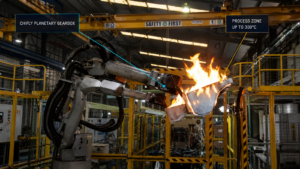
Customer-application visual based on field footage, showing the marked location of a CHIFLY planetary gearbox integrated close to an open-flame high-temperature process.
A real high-temperature planetary gearbox application
The field image shows the CHIFLY planetary gearbox mounted close to the customer’s flame-based process. Its role is part of a working machine, not a showroom display or a room-temperature demonstration.
That distinction matters. A component used in production has to fit the available space, transmit the required torque and support the machine’s operating cycle. Near a high-temperature process, it must do all of this while the surrounding thermal conditions continue to change.
For the customer, the value is not simply that the gearbox can rotate. The transmission has to support repeatable machine movement without allowing heat-related changes in lubrication, sealing, internal clearances or mounting conditions to undermine the application.
The transmission task remains precise, even when the process is hot
High-temperature equipment does not remove the usual requirements of a precision transmission system. It adds another layer of risk to them.
Transmission requirements
- Required output torque within a compact installation space
- Torsional rigidity for stable response under changing load
- Controlled backlash for reversing and positioning movements
- Consistent input, output and mounting support
- Reliable operation across the customer’s actual duty cycle
These characteristics explain why a precision planetary gearbox is useful in tightly integrated industrial machinery. They also explain why heat management cannot be treated as a separate afterthought. Any thermal change that affects lubrication, bearing support or gear mesh can eventually affect the same motion performance the gearbox was selected to deliver.
How heat reaches the gearbox
The process-zone temperature alone does not describe the thermal load on the gearbox. What matters is how heat travels from the process to the installation point.
Flame and hot surfaces can heat the housing without direct contact. Distance, orientation and shielding all matter.
Hot air transfers heat to the housing. An open installation and an enclosed hot-air pocket behave differently.
Brackets, mounting plates, shafts and the machine frame can carry heat into the gearbox.
Gear mesh, bearings, seals, speed and transmitted load add the gearbox’s own temperature rise.
The final operating temperature is the result of these heat paths acting together. That is why CHIFLY evaluates gearbox position, distance from the heat source and surrounding structure alongside torque, speed and ratio.
What high temperature can change inside a planetary gearbox
Lubrication condition
As temperature rises, lubricant viscosity can fall and the lubricating film can become thinner. Oxidation and ageing may also accelerate. The lubricant therefore has to be reviewed against the local gearbox temperature, load, speed and service interval, not against the process temperature alone.
Sealing performance
Seal materials have defined temperature limits. Prolonged heat exposure can change hardness and elasticity, increasing the risk of lubricant leakage or contamination entering the gearbox.
Bearings, fits and preload
Shafts, bearings and housings do not necessarily expand by the same amount. Thermal growth can change internal clearance or preload. Too little clearance can increase friction and temperature; too much can reduce rigidity and affect vibration or positioning.
Backlash and positioning behaviour
Low backlash depends on stable gear contact, bearing support and mounting geometry. Lubrication changes, thermal expansion and deformation of the surrounding structure can alter those conditions. Maintaining controlled positioning performance in a hot machine is therefore more demanding than operating the same transmission at room temperature.
Engineering perspective
High-temperature capability is more than special grease.
High-temperature lubricant may be part of the solution, but it cannot raise the temperature capability of every seal, bearing fit, motor interface or mounting component around it.
A stronger solution starts by identifying the real temperature at the gearbox location. Engineers can then review the lubricant, seals, internal fits and duty cycle against that measured condition. If most of the heat comes from the process, changing the installation may be more effective than changing the gearbox alone.
- Increase the distance from the heat source
- Add a radiant heat shield
- Reduce conduction through the mounting structure
- Improve ventilation or local cooling
- Review lubrication, materials and any required derating
This system-level approach is an important part of CHIFLY’s application support. The product, mounting structure and operating environment have to work as one transmission solution.
What this customer case demonstrates about CHIFLY
The strongest evidence in this case is straightforward: a CHIFLY planetary gearbox has moved beyond a catalogue and into a customer’s working high-temperature process machine.
It shows that CHIFLY products can be integrated into demanding industrial equipment where installation space, heat exposure and transmission performance must be considered together.
It also shows that the engineering conversation extends beyond nominal torque and ratio. For similar projects, the relevant inputs include local temperature, heat-source position, mounting layout, load, speed, acceleration and duty cycle.
The case does not replace temperature measurements or a project-specific review. It does provide real-world evidence that CHIFLY planetary gearboxes are being applied in complex high-temperature process equipment.
How to validate a similar installation
A machine completing one cycle is a useful start, but it is not enough to establish long-term stability. A controlled validation should record how the installation behaves as it warms up and reaches a repeatable thermal state.
- Gearbox housing temperature from cold start to thermal stabilisation
- Load, speed, acceleration and continuous running time
- Noise, vibration and smoothness as temperature rises
- Any lubricant leakage around the seals
- Backlash, repeatability or output condition before and after the trial
- Shielding, airflow and mounting conditions used during measurement
These records turn a general statement such as “the process reaches 300°C” into information that can guide gearbox configuration, installation changes and maintenance planning.
Planning a high-temperature transmission application
For equipment with a furnace, flame, heated tooling or another concentrated heat source, send CHIFLY the installation layout, local temperature information, required torque, speed, ratio, acceleration and duty cycle. Available shielding, ventilation, cooling and positioning requirements should also be included.
CHIFLY can use these inputs to review the application conditions and help identify a suitable planetary gearbox configuration, together with the installation and thermal-management points that need attention.
Evaluating a planetary gearbox for high-temperature equipment?
Send your layout, temperature information and motion requirements to the CHIFLY engineering team.