





Avoid your inquiry is delay response, please enter your WhatsApp/Skype along with the message, so we can contact you at the very first time.
We will reply you within 24 hours. If for urgent case, please add WhatsApp/WeChat: +86 19966487626,. Or call 400-090-5086 directly.
* We respect your confidentiality and all information are protected. We will only use your information to respond to your inquiry and will never send unsolicited emails or promotional messages.
Gearbox Noise Diagnosis: What Whining, Humming, Clicking, and Grinding May Indicate
A practical guide to using sound, operating conditions, and repeatable measurements to narrow the source of gearbox noise.
A gearbox that has run quietly for months starts to whine under load. The sound seems loudest at the housing, so the gearbox gets blamed first.
That conclusion may be right. It may also lead the inspection in the wrong direction.
Noise measured at a gearbox can originate in the gears or bearings, but it can also travel through the motor adapter, mounting plate, output support, or driven machine. The housing may simply be the surface radiating the sound. Siemens makes the same distinction in its geared-motor guidance: noise emitted by a gearbox is not necessarily generated inside it.
The useful question is not, “What does this sound mean?” It is:
Under which speed, load, temperature, and direction does the sound appear or become stronger?
That relationship usually tells an engineer more than the sound description alone. At CHIFLY, we treat the sound description as a starting point, not the diagnosis.
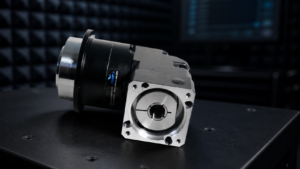
CHIFLY precision planetary gearbox shown in an acoustic test setting. The edited scene combines a real CHIFLY product photograph with a reconstructed laboratory background.
Gearbox noise diagnosis
Start with the operating pattern
Words such as whine, hum, click, and grind are subjective. Use them to describe what you hear, not to declare a failed component.
| Sound description | Inspection direction | Useful observation |
|---|---|---|
| High-pitched whine | Gear mesh, uneven tooth contact, alignment, lubrication, structural resonance | Does pitch follow speed? Does amplitude rise under load? |
| Steady hum | Motor or drive excitation, normal mesh components, brake, fan, machine-frame resonance | Does it follow motor speed, electrical excitation, or one narrow speed range? |
| Rhythmic clicking or knocking | Clearance take-up, loose connection, local tooth or rotating-component irregularity, shaft runout | Is the repetition rate tied to a shaft revolution? Does it occur only at reversal? |
| Rough grinding or scraping | Bearing or tooth-surface damage, lubricant contamination or loss, interference, foreign material | Did it appear suddenly? Is temperature or vibration rising with it? |
Two faults can sound alike. One fault can produce several sounds. Treat the table as a way to set inspection priorities.

Figure 1. Whining, humming, clicking, and grinding help prioritize the next inspection. They do not identify a failed part by themselves.
Gearbox noise diagnosis
High-pitched whining and gear mesh
Gear meshing creates periodic excitation even in a healthy gearbox. For a simple fixed-axis gear pair, the gear mesh frequency is:
fGMF = fshaft × Z
Here, fshaft is the rotational frequency of that gear and Z is its tooth count. Both gears in the pair produce the same mesh frequency.
As shaft speed rises, the mesh frequency rises. A gear-related tone will often move upward in pitch as well. Its amplitude, however, depends on much more than speed: transmitted load, tooth contact, manufacturing variation, lubrication, bearing support, housing response, and the stiffness of the installed machine all matter.
Precision planetary gearboxes need a separate note. Their vibration pattern cannot be reduced to one shaft speed multiplied by one tooth count. Sun, ring, planet, and carrier motion all contribute, while the number of planets and the sensor position affect the measured modulation and sidebands. Use the gearbox architecture and tooth data to calculate the expected orders before assigning a spectral peak to an internal component.
A stable whine that has been present since commissioning may be part of the machine’s normal acoustic signature. A new tone, a rapid increase, or a clear load-dependent change deserves inspection.
Start with these points:
- Mounting-flange flatness and fastening torque
- Motor-to-gearbox alignment and connection
- Output-side support and applied radial or axial load
- Lubricant specification and condition, where serviceable
- Bearing support, internal clearance, or preload, assessed by the manufacturer or qualified service personnel
- Flexible plates, guards, and frames that can amplify normal excitation
SEW-EURODRIVE lists housing deformation during tightening and insufficient foundation rigidity among the possible causes of unusual running noise. That is general industrial gear-unit guidance, not a diagnostic limit for every precision planetary gearbox, but the installation principle still matters: a precise gearbox cannot correct a distorted mounting interface.
Gearbox noise diagnosis
Humming and transmitted vibration
A steady hum does not automatically indicate damaged teeth. The source may be the motor, servo drive, brake, cooling fan, or machine structure. Vibration can then travel through the assembly and radiate from the gearbox housing.
Check whether the hum changes with motor speed, load, drive settings, or brake state. A sharp increase within a narrow speed band raises the possibility of structural resonance.
Do not test that possibility by casually changing production speed. Use an approved, controlled speed sweep within the machine manufacturer’s limits. If noise and vibration peak in a narrow band and fall on either side, inspect the baseplate, guard, bracket, and mounting structure before opening the gearbox.
Vibration data helps separate these sources. Overall vibration shows that the machine has changed; a spectrum shows which frequency has changed. Time waveform, FFT, order tracking, and envelope analysis each answer different questions.
Gearbox noise diagnosis
Clicking and knocking
With clicking, rhythm matters more than loudness.
Count the events and compare them with known shaft speeds. One event per input-shaft revolution moves the inspection toward input-side rotation. One per output-shaft revolution shifts attention toward the output shaft, output connection, or a component rotating at that speed. This is a lead, not proof. A local gear defect may also appear as modulation around the mesh frequency rather than as a clean audible click.
Reversal needs careful interpretation. When torque changes direction, the load transfers to the opposite tooth flanks and clearances are taken up. One small, repeatable click can be normal for the design. It becomes more concerning when it is new, grows over time, is accompanied by excessive lost motion, or appears with a loss of positioning accuracy.
Before blaming the gears, check:
- Commanded acceleration and jerk
- Backlash against the gearbox specification
- Motor adapter and clamping connection
- Coupling, key, or shrink connection, where used
- Output flange, bolts, and driven component
SEW-EURODRIVE identifies knocking as a possible sign of a gearing irregularity and irregular running noise as a possible sign of foreign material in the oil. Its own action is to stop the drive and contact service when an internal foreign object is suspected. The sound alone still does not confirm which condition is present.
Gearbox noise diagnosis
Grinding and scraping
A new grinding or scraping sound deserves a faster response than a stable hum. Possible causes include bearing-surface damage, lubricant loss or contamination, damaged tooth surfaces, severe misalignment, unintended contact, or foreign material.
Do not extend a test run to collect more data when grinding is accompanied by any of the following:
- Rapidly rising housing temperature
- A step change in vibration
- Metallic impacts or unstable output motion
- Visible metal flakes or chips in the lubricant
- Oil loss together with a marked change in sound
- Smoke, burning odour, or a protection alarm
Stop the drive using the machine’s approved procedure. Isolate stored mechanical energy before inspection. Keep guards in place during any operating measurement and never place a hand-held probe on a rotating coupling or shaft.
Gearbox noise diagnosis
Three controlled comparisons
Good troubleshooting changes one variable at a time.
No-load and loaded operation
Keep speed and temperature as consistent as the machine allows, then compare approved no-load and loaded conditions. A large load-dependent increase points toward force-related effects such as tooth contact, overload, shaft or flange alignment, housing deformation, output support, or structural flexibility.
Some increase under load can be normal. Compare the result with the gearbox baseline and the manufacturer’s acceptance conditions rather than judging the sound in isolation.
Cold and thermally stable operation
Record sound, vibration, and housing temperature after start-up and again after the machine reaches a repeatable, thermally stable condition. A change after warm-up can be related to lubricant viscosity, thermal expansion, seal friction, bearing clearance, preload, or a shift in alignment.
For a sealed precision gearbox, this is diagnostic information, not permission to open the unit or change its lubricant. Follow the product’s service instructions.
Forward and reverse operation
Compare directions only when reverse operation is permitted. A direction-dependent running sound can result from different loaded tooth flanks, alignment under torque, or clearance in the output connection. An impact confined to reversal also warrants a review of the motion profile.
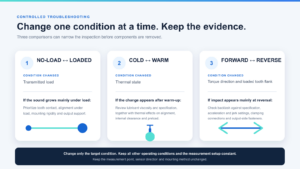
Figure 2. Change one target condition at a time: transmitted load, thermal state, or torque direction. Keep the other operating conditions and the measurement setup constant.
Gearbox noise diagnosis
Make the measurements repeatable
A phone recording is useful when a remote engineer needs to hear the character and rhythm of a sound. It is poor evidence for a quantitative decibel comparison because phones commonly apply automatic gain, compression, and noise reduction.
For repeatable acoustic records, keep the microphone, distance, orientation, gain setting, and surrounding conditions unchanged. Note the operating speed, load, direction, and housing temperature with every recording.
Vibration measurements need the same discipline:
- Use the same rigid measurement point
- Keep the radial or axial sensor direction unchanged
- Use the same sensor mounting method
- Keep measurement range, bandwidth, sampling, and processing settings consistent
- Record speed and load with the vibration data
A single dB value or overall vibration number has little diagnostic value without this context. Trend data collected under repeatable conditions is far more useful.
Gearbox noise diagnosis
Record evidence before changing the machine
Do not change lubricant, alignment, servo parameters, and mounting conditions at the same time. The noise may disappear, but so will the evidence needed to identify the cause.
Capture the gearbox model, ratio, motor, input speed, load or operating torque, direction, mounting arrangement, cold and warm temperature, and service history. Add fixed-position audio and vibration data where available. If lubricant inspection is permitted, distinguish a normal fine run-in residue from unusual flakes, chips, or a rising wear-debris trend.
General industrial gear-unit manuals are useful for troubleshooting principles, but they do not replace the limits and service procedures for a specific precision planetary gearbox. Model-specific data wins. When available, confirm the exact series and ratio against the supplier’s product documentation.
Gearbox noise diagnosis
Sound narrows the search; evidence identifies the cause
Whining, humming, clicking, and grinding are useful descriptions. None is a diagnosis.
Connect the sound to speed, load, temperature, direction, and repetition rate. Then verify the suspected source with vibration, temperature, lubricant, alignment, and mechanical inspection data. That is how an engineer separates an internal gearbox problem from a motor, mounting, control, or load-side issue.
When you contact CHIFLY for troubleshooting support, provide the gearbox model and ratio, motor information, operating speed, load condition, mounting arrangement, and a recording made under clearly stated conditions. A controlled comparison is more useful than a louder recording.
Gearbox noise diagnosis
References
Need engineering support?
Send CHIFLY the model, ratio, speed, load, mounting arrangement, and a controlled recording.